
4 Lanes - New format, new challenges

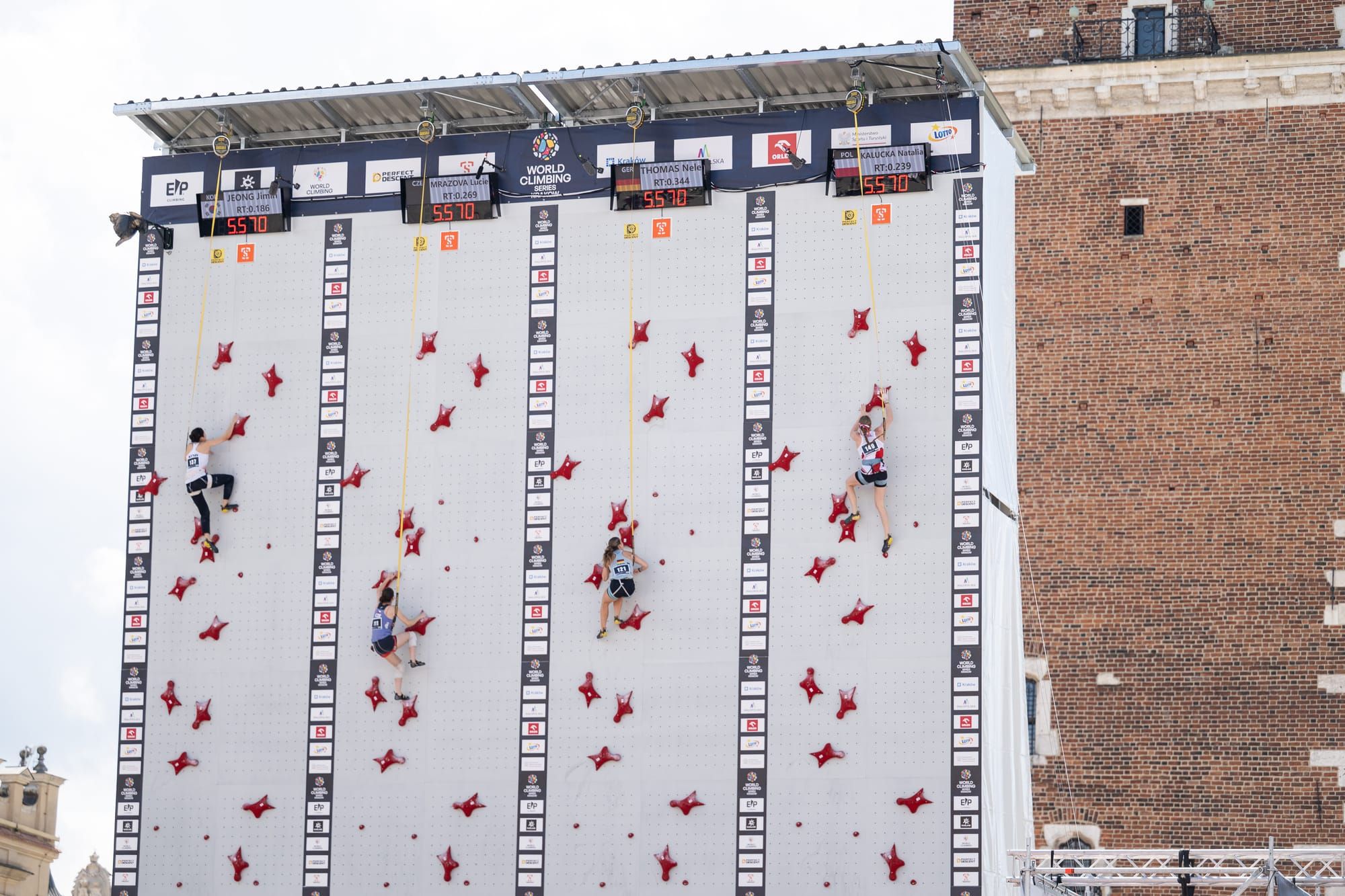
New format new challenges and new discussions. The 4 lane competition is a brand type of competition that brings with it new questions.
Numbers shows an objective picture of the situation, we would like to speak with you all to understand what could be a more subjective and comprehensive analysis of that new format.
First of all, for sure it’s a fantastic new format, 4 athletes, every run is a challenge from the start to the end, no more fatal mistakes or weird runs, practically every time we have someone that does a good run, and like this the show always goes on!
Of course this brings some questions:
- Is every lane the same? Friction wise
- Is there a lane that is harder to manage? Environment wise
- Is the light under hold 3 disturbing :D
- Should World Climbing homologate the record for the first run of the relay format?
So let’s analyze these points, both objectively and subjectively
First – is every lane the same?
We really can’t know it till World Climbing will share the results of the pilot study around friction measurements of the wall friction, logically thinking, of course every batch of panel has some differences in both, wood quality, paint thickness and quartz distribution but it’s also true that the manufacturing process became always more and more automated. And so, as the old man says, only time (World Climbing) will tell.
Second – Is there a lane that is harder to manage? Environment wise
Talking about this, we pointed at some variables that could influence the environment of the athlete:
Field of view – of course you see something else other than your lane, and in the case of the 4 lanes format, lane C and D will have a drastic change, having 2 or 3 athletes in your field of view during the start could be distracting and so, an opportunity to make small mistakes.
Proximity of the athletes – having athletes on both sides can change a bit how you feel on the wall, maybe more pressure and more inputs from the sides can also be a distracting factor to keep into consideration, so in this case, lane B and C could be harder to manage.
At his point, what could be the “hardest” to manage lane? The only lane with both variables present is lane C, and so it could be, in this format, the most difficult to manage environment wise.
WANT A NUMERICAL ANALYSIS? WE MADE ONE AT THE END OF THE ARTICLE!
Third – light under hold 3, is it disturbing?
World Climbing, for the Relay format of the competition, decided to install a light under hold number 3, to signal to the second athlete of the relay, with a light signal, that the first athlete arrived at the top and pressed the button.
This light was also present during the 4 lane single event and many athletes pointed at it.
Of course it’s an extremely small tweak, but in some cases, like a bee on a hold, could be a distracting factor for an athlete and, at the end, many athletes said it wasn’t helpful to reduce the reaction times.
What do you think about that?
Fourth - Should World Climbing homologate the record for the first run of the relay format?
The first run of the relay format is a normal run, as all the single runs, and so it could be homologated as a normal run and an opportunity to beat in a less stressing occasion.
So what is your opinion, should they keep the time or leave it?
Here, what you all waited for, a numerical analysis about the performances on the 4 lanes competition in Krakow!
So, we took all the qualification times of the athletes and made an analysis based on the PB of the competition for every single athlete.
We made 3 analysis to remain as objective as possible:
- General ranking based on the times of every run – the fastest will get 4 points the slowest 1, the lane with the higher points will be the fastest one.
- Ranking based on the difference between the best time and the specific lane time – summing all the data, the lane with the highest sum will be the “slowest”, the one with the lowest sum will be the “fastest”.
- Ranking based on the difference between the best time and the specific lane time cutting out the differences over 3 seconds, to remove the extremes that can alter the analysis – ranking as the previous one
- Simple ranking based on the total number of FALLS in every lane
Let’s separate Women and Man
WOMEN
In the first and second case (General ranking and PB Difference) lane C seems to be the worse, but, if you cut out the times over 3” from the Krakow competition PB, the situation changes and became the second worse leaving the “worst lane” award to lane D.
What does it mean? That the mistakes on lane C makes the athletes lose more time than in the other lanes. That brings some very high times on that lane that can alterate the statistical analysis if not taken into consideration.
Lane B and A seems to be always better than the other 2.
But what about the numbers?

Here we can see the two analysis, so how much can it impact?
If we take into consideration all the times, if you're a woman running on lane C you could lose a full second from the best lane, and on average around 0.84"!!
MEN
In this case we have a clear winner, lane A is the best to make the new World Record! Than we can see a clear loser, lane C, that in all 3 analysis remains the worst one.
If we watch the mean time loss per lane we can see that lane A has a mean loss of .68” for the W and .43” for the M, lowering it down to .42” and .28” respectively with the 3” cut out of the data.
Lane C instead has a mean loss of 1.59” for the W and 1.23” for the M, lowering and changing them drastically to .45” for the W and .72” for the M with the 3” cut of the data.
This means, between the best and the worst lane (Lane A vs Lane C), a difference of 1.01” for the W and a loss of 0.03” with the cut, and for the M always a clear loss of .80” and .44” with the cut.

So, can we say that lane C is the worst lane to run on? For sure we need more data, but for now, it could be that probably the environment is influencing the concentration of the athletes perturbating their performance.
See you at the next article!